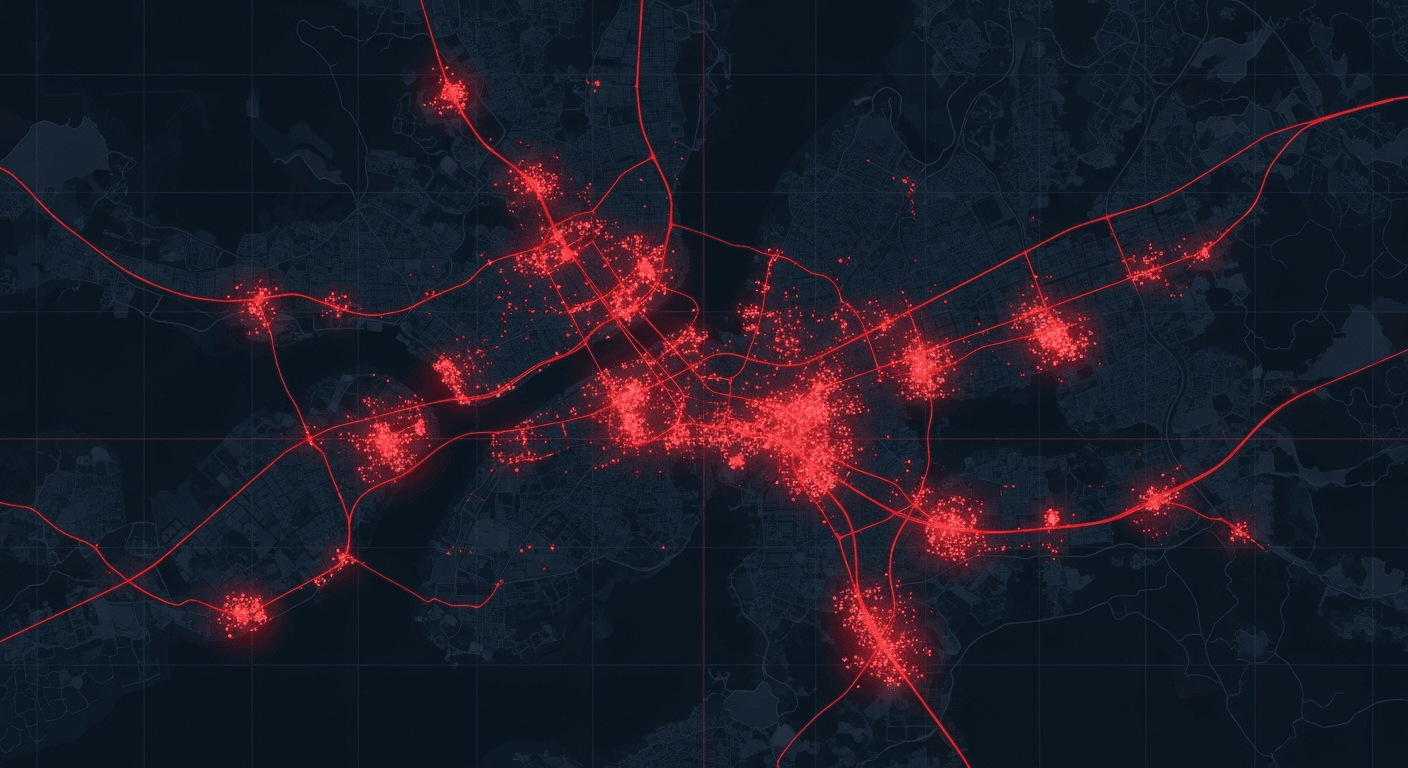
Armed robbery is the most frequently reported incident category on Chipon — making it the single most reported category in Lagos. We owe it to our community to analyze this data rigorously and share what we find.
This analysis covers armed robbery reports from community data and cross-referenced with published Nigerian crime research. Every report in our dataset has been verified by at least 5 independent users and cross-referenced against news coverage where available.
When It Happens
Time of Day
- Peak window: 10 PM – 1 AM (38% of all reports)
- Secondary peak: 4 AM – 6 AM (14%) — targeting early commuters and overnight travelers
- Lowest risk: 10 AM – 3 PM (7%)
Day of Week
- Highest: Friday and Saturday (combined 41%)
- Lowest: Sunday and Monday (combined 18%)
- Mid-week (Tue-Thu) is evenly distributed at about 41%
Monthly Patterns
There is a notable spike in December and January (holiday season) and a smaller spike in March-April (end of first quarter, school resumption). The safest months historically are July-August, likely due to reduced movement during peak rainy season.
Where It Happens
The geographic patterns cluster into three environment types:
1. Transit Corridors (47% of reports)
The most common setting. Victims are targeted while in transit — in traffic, at bus stops, or walking between transport connections. Key hotspots:
- Lekki-Epe Expressway (particularly the dark stretch beyond Chevron)
- Apapa-Oshodi corridor
- Ikorodu Road between Ketu and Mile 12
- Third Mainland Bridge approaches
2. Residential Streets (31%)
Victims targeted near their homes — arriving home late, leaving early morning, or on the short walk from a ride-hailing drop-off to their door. Interior residential streets with poor lighting are the most common setting.
3. Commercial/Social Zones (22%)
Around markets, ATMs, nightlife areas, and parking lots. These incidents often involve victims who have just withdrawn cash or are visibly carrying valuables.
How It Happens
The method patterns are consistent enough to define three primary modes:
The Traffic Stop (most common)
Perpetrators approach vehicles stuck in traffic or at red lights, typically on motorcycles. They target the driver's window. This mode accounts for the majority of transit corridor incidents and follows a predictable script: approach on the left (driver's side), tap on window, display weapon, demand phone and cash.
The Ambush
Concentrated on dark residential streets. Perpetrators wait in a concealed position (behind parked cars, in alleys, at blind corners) and approach victims on foot. Most common between 10 PM and midnight when residents are returning home.
The Trail
The most sophisticated method: following a target from a bank, ATM, or market to a quieter location before approaching. Chipon data shows these incidents often occur 500-800 meters from the initial observation point (ATM, bank, etc.).
What the Data Suggests for Prevention
Based on these patterns, five data-backed strategies:
- Minimize the 10 PM – 1 AM transit window. If you can complete your evening movement before 10 PM, you avoid the peak risk period.
- Avoid dark transit corridors at night. Check Chipon's heatmap for your route. If segments are in orange or red zones, consider an alternative even if it adds time.
- Vary your routine for the last 200 meters. The “trail” pattern relies on predictable behavior. Changing your final approach to home, varying which street you use, reduces vulnerability.
- Be especially alert after ATM visits. Consider withdrawing cash during business hours inside bank branches rather than from street ATMs in the evening.
- Report immediately. If you witness or experience an incident, file a Chipon report in real-time. Your 30-second report creates a warning zone that protects everyone behind you.
A note on this data: Our goal is to inform, not to frighten. Understanding patterns is the foundation of prevention. The vast majority of Lagosians navigate these risks every day without incident — and that number increases when people are armed with good information.
Chipon exists to close the information gap between knowing something happened and knowing it before it happens to you.